Getting Spray Foam Out of a Loft Without Wrecking the Roof
Open & Closed Cell Spray Foam Removal in Leeds — protect property value, ease mortgage compliance, restore roof health. Free survey available.
Getting Spray Foam Out of a Loft Without Wrecking the Roof
Whether you’re dealing with open cell or closed cell foam, taking it back out of a loft is a different job entirely from putting it in — and it’s the part most installers don’t want to talk about. If a mortgage lender, RICS surveyor, or your own common sense has flagged foam insulation in your Leeds property as a problem, you need someone who’s spent as much time removing the stuff as fitting it.
We do both. That matters, because a contractor who only installs foam has no real reason to understand how it fails, how it bonds to timber, or what a lender actually wants to see once it’s gone. We survey the roof first, tell you honestly what’s involved, and quote a fixed price before anything gets touched. Every job comes with a completion certificate and sits behind a 25-year guarantee — same as our installation work.
What Actually Happens When Foam Comes Out
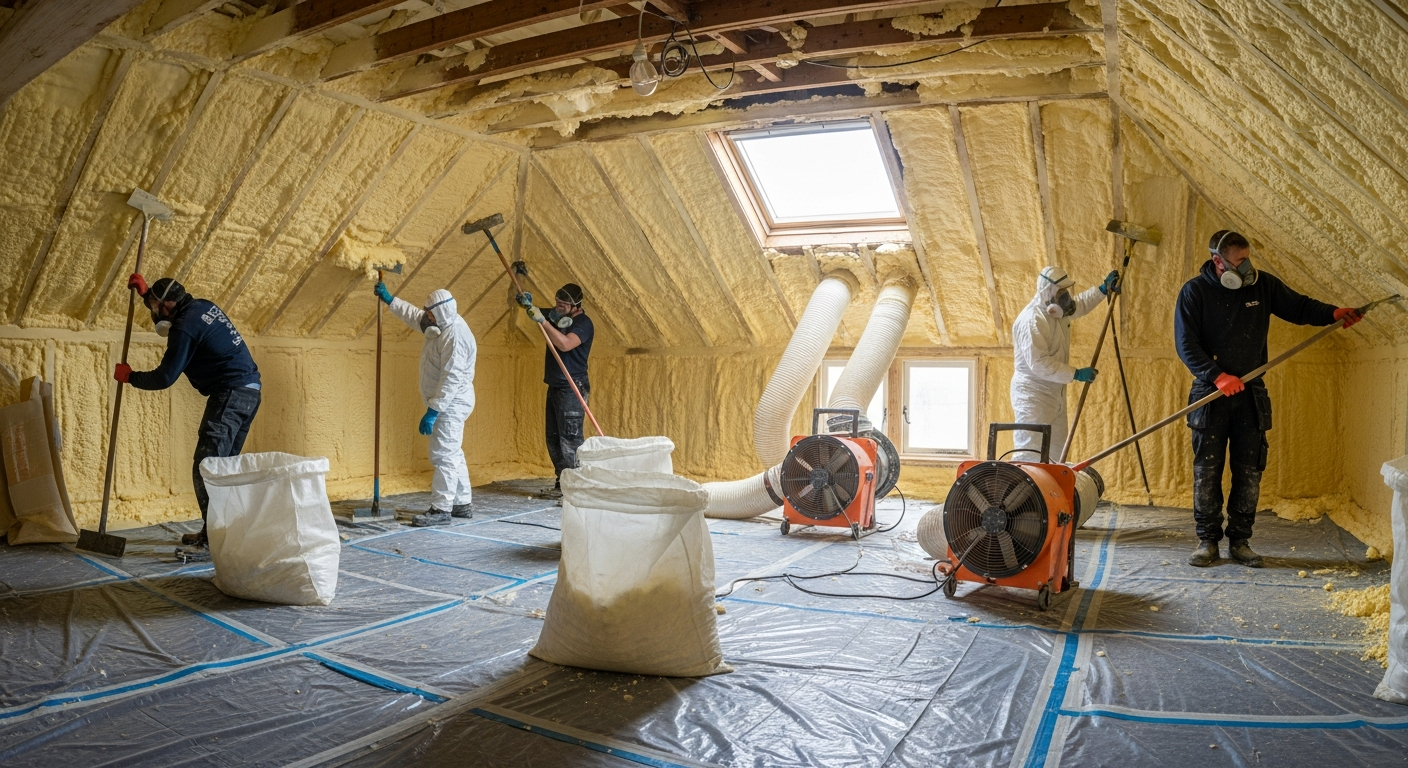
Spray foam removal isn’t a case of peeling off a layer and sweeping up. Both open cell and closed cell foam bond directly to the timber rafters, sarking felt, and sometimes the underside of roof tiles. Closed cell foam in particular can be like trying to chip cement off brick — it’s rigid, it’s adhered, and it’s often been sprayed thick enough to fully encapsulate the timber.
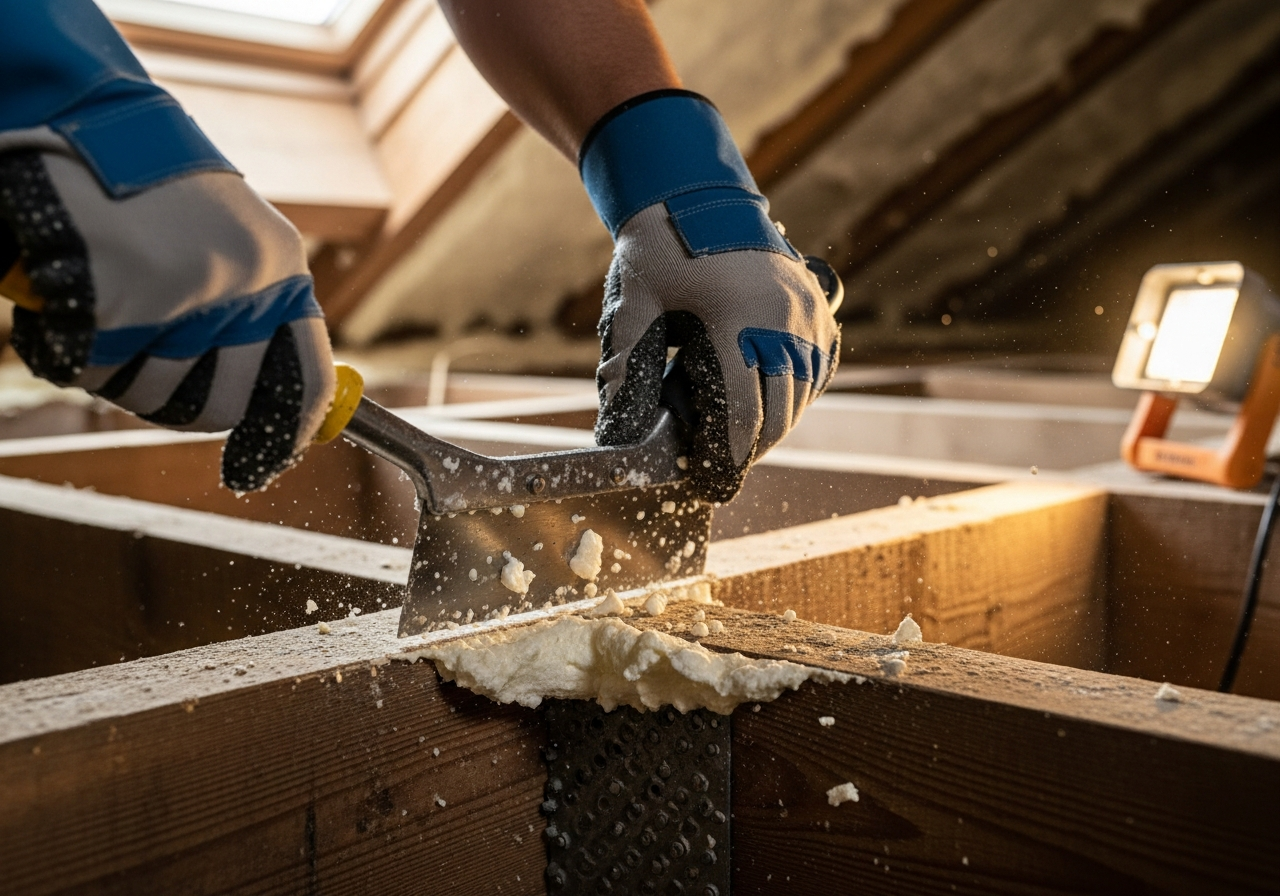
The process is mechanical, not chemical. We use a combination of manual scraping, air chisels, and — for stubborn closed cell areas — rotary tools to lift the foam away from the timber without gouging or splintering it. Every rafter gets stripped back to bare wood, because leaving foam residue behind defeats the point of the job; lenders and surveyors want to see clean timber, not a thinner layer of the same problem.
Once the foam is off, we inspect every rafter, purlin, and section of sarking felt underneath. This is usually the first time in years anyone’s actually seen the timber — foam has a habit of trapping moisture against wood and disguising rot until it’s advanced. We flag anything that needs treating or replacing before we talk about re-insulating.
Who Tends to Need This
Most of our removal enquiries come from one of four situations. The first is a mortgage application or remortgage where the surveyor has entered a note on the valuation report saying foam is present and needs specialist investigation before lending proceeds. The second is a house sale falling through, or being delayed, because the buyer’s solicitor has picked up on foam during searches. The third is homeowners who’ve simply noticed damp patches, a musty smell, or dark staining on ceilings and want to know what’s happening above their heads. The fourth is people who had foam fitted years ago by a cheap installer, before the RICS guidance changed, and now can’t get it mortgaged or insured.
Property type doesn’t matter much — we’ve stripped foam from 1930s semis in Roundhay, ex-council terraces in Beeston, and self-build barn conversions out towards Wetherby. What matters is the roof structure and how thickly the foam was originally applied.
From Survey to Completion
1. Free survey and assessment. We get into the loft, check what type of foam is present, how it was applied, and the condition of the timber underneath as far as we can see it. This is genuinely free and comes with no obligation.
2. Fixed quote. You get a written price based on loft size, foam type, and access — not a vague estimate that changes once the van’s on your drive.
3. Foam removal. Mechanical stripping back to bare timber, working section by section across the roof.
4. Timber inspection and treatment. Any rot, insect damage, or damp staining gets identified and treated or replaced as needed.
5. Waste disposal. Foam is removed from site and disposed of responsibly — it’s not something you can put out with the bins.
6. Certification. You receive a completion certificate confirming the foam has been fully removed and the roof timbers inspected, which you can pass to your lender, surveyor, or buyer.
What You Actually Gain
The main driver is usually mortgage compliance — getting a clean roof void that a valuer or RICS surveyor can sign off without conditions attached. Beyond that, most homeowners are surprised by the secondary benefits: proper roof ventilation returns once the foam is gone, which stops the trapped-moisture problems that caused issues in the first place. Timber that’s been hidden under foam for a decade often needs attention regardless of the sale — this is your chance to deal with it before it becomes structural.
There’s also the insurance angle. Several major insurers have started asking direct questions about foam insulation at renewal, and a completion certificate showing professional removal answers that question cleanly rather than leaving it open.
Open Cell Spray Foam Removal
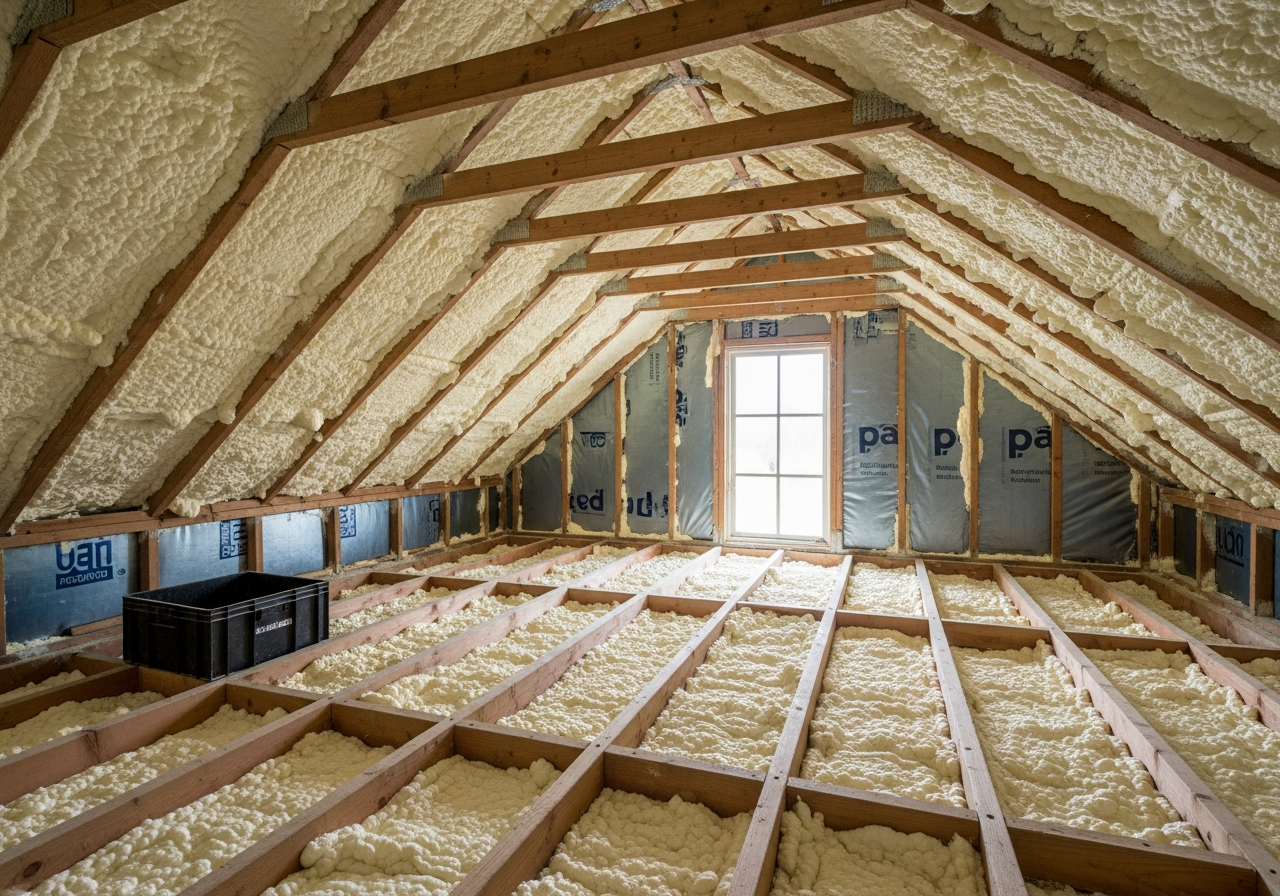
Open cell foam is the softer, more flexible of the two types — lighter in density, greyish or white in colour, and easier to compress with a thumb. Because it doesn’t bond quite as aggressively as closed cell, it’s generally more straightforward to remove, though “straightforward” is relative; it still adheres firmly to felt and timber and has to be worked off carefully rather than pulled.
This type of removal tends to suit homeowners whose foam was applied more recently, or where the surveyor’s concern is less about bonding damage and more about the fact that open cell foam holds moisture against the roof timbers and sarking felt, accelerating felt breakdown. We see a fair amount of open cell foam in lofts across Leeds where it was fitted as a quick energy-efficiency upgrade five to ten years ago, before the lending market caught up with the risks.
The benefit for you is a quicker job with less mechanical intervention than closed cell removal typically needs, meaning lower labour time and a faster route to a clean loft and completion certificate.
Closed Cell Spray Foam Removal
Closed cell foam is denser, rigid, and far more firmly bonded — it’s the type most likely to have been sprayed directly onto the underside of roof tiles as well as the timber, which creates two separate removal problems rather than one. It doesn’t compress under thumb pressure, feels almost like hard plastic foam board, and is usually a pale yellow or cream colour.
This is the harder of the two removal jobs and the one where inexperienced contractors get caught out — attempting to lever closed cell foam off timber without the right technique splits rafters and cracks tiles. It suits situations where foam has clearly been over-applied, where it’s encasing electrical cabling or pipework (a genuine fire-safety and access concern), or where a surveyor has specifically noted “closed cell” on their report, since lenders often treat it as higher risk than open cell.
The benefit here is thoroughness done properly: full mechanical removal from both timber and tile without collateral damage, followed by an honest assessment of what condition your roof structure is actually in underneath.
What It Costs and How Long It Takes
Pricing depends on loft size, foam thickness, foam type, and access. As a rough guide, a typical semi-detached loft runs somewhere between £2,500 and £5,500 for full open cell removal, and £3,500 to £7,000+ for closed cell, given the extra labour involved in stripping it back safely. Larger detached properties, dormers, or lofts where foam was also sprayed onto gable walls will sit higher.
Most domestic jobs take between two and four days on site, though heavily foamed closed cell roofs or properties with restricted access can run longer. The free survey takes about 30–45 minutes and gives us enough information to provide a fixed written quote — nothing gets scheduled until you’ve seen the price and agreed to it.
Common Questions
Will removing the foam guarantee my mortgage gets approved? No contractor can promise that — the lending decision sits with your bank and their surveyor. What we can guarantee is a clean roof void, a completion certificate confirming professional removal, and timber left in a condition a surveyor can properly assess. That’s the strongest position you can be in going into a revaluation.
How do I know if I’ve got open cell or closed cell foam? Open cell is soft, flexible, and compresses under light pressure — usually grey or white. Closed cell is rigid, dense, and feels almost like hard plastic — usually cream or pale yellow. If you’re not sure, send us a photo from the loft hatch and we’ll tell you before we even book a survey.
Will removal damage my roof tiles? It can if it’s rushed or done with the wrong tools, particularly with closed cell foam sprayed directly onto tile undersides. We work slowly in those areas specifically to avoid it, and we’ll flag before starting if we think any tiles are already compromised by the original spray application.
What happens to the timber once the foam is off? We inspect every rafter and section of felt for rot, insect damage, or moisture staining. Anything affected gets treated or replaced as part of the job — we don’t hand back a loft with hidden problems just because the foam’s gone.
Can I stay in the house while the work happens? Yes. It’s noisy in short bursts, particularly during closed cell removal, but it doesn’t affect water, power, or living space. Most homeowners carry on as normal while we’re in the loft.
Get a Straight Answer on Your Roof
If a surveyor’s report, a mortgage query, or your own instinct has raised a question about foam in your loft, the fastest way to get a clear answer is a free, no-obligation survey. We’re open seven days a week, 9am to 7pm, across Leeds and the surrounding areas — call us or book online and we’ll tell you honestly what we find, what it’ll cost, and what we’d do in your position.

How It Works
From initial survey to completion — here’s what to expect when you work with us.
-
Free Survey
We take a look at your property and tell you exactly what we find — no guesswork.
-
Straight Quote
A clear, itemised quote within 48 hours. No hidden costs, no pressure to decide on the spot.
-
The Work Itself
Our team carries out the job to BBA-approved standards, with minimal disruption to your home.
-
Final Check
We check the finished work with you, tidy up properly, and explain what we did and why.
Ready for a Free, No-Obligation Survey?
We'll take a look, tell you exactly what we find, and give you a straight quote — no pressure, no upselling.